Friday, May 23, 2008
In a remarkable display of military efficiency, I am now scheduled for one class over the next seven days. I don’t why it ended up this way, but it’s a big waste of people’s time and government money. A lot of people are upset over this, especially folks who are deploying straight to Iraq from this training. They’re bitter that they have to sit here on post under General Order No. 1, when they could be spending a few extra days with family before leaving the country. If I think about it too much I could also get bitter, so I try not to think about that. It is what it is. One senior NCO in our command actually told us to “stay motivated even if we have to be motivated while doing nothing.” Today we had a one hour block of instruction and the rest of the day free. The holiday weekend is completely open. On the surface this seems like a good situation, but when you are restricted to Fort McCoy it becomes less than good. Luckily I have made a few good friends with whom to pass the time and I have been logging huge hours at the gym. I’ve finished two books, listened to over 500 tracks on my iPod, watched several DVDs and I’ve been able to write almost everyday. Parole board meets in less than a week.


Thursday, May 22, 2008
Baghdad Bureau
I've followed this blog for a little while. Interesting and seemed to echo some of my thoughts from yesterday.

Wednesday, May 21, 2008
Relevance
Overall I have learned a lot of basic military skills which, even if I don’t actually have to exercise them, my level of knowledge will hopefully keep me from looking like an idiot when I enter “Army world” in Afghanistan.
The major themes of the course have become very clear: immediate first aid response, identifying and/or avoiding IEDs, and weapons familiarization. I am assuming this is a reflection of the reality of the wars these days.
On that note, one of the instructors in the combat lifesaver course told the class today that someone from the class in April had just been involved in an IED blast and lost a leg right after getting in country.
Being tucked away here, living and breathing the military life as I prepare to deploy, I have realized a few things (apart from the fact that I don’t like it). I have had an awareness that I generally haven’t talked about/thought about how soldiers, sailors, and airmen are dying in Iraq and Afghanistan every day. Even if a day goes by without a death, someone was having a close call, getting a limb blown off or getting their brain sloshed in their skull. Not that we forget, but it doesn’t seem like it is a prominent thing, because it doesn’t have that much relevance to our everyday lives. That’s not a profound insight but this sure is becoming relevant in my little world…
The major themes of the course have become very clear: immediate first aid response, identifying and/or avoiding IEDs, and weapons familiarization. I am assuming this is a reflection of the reality of the wars these days.
On that note, one of the instructors in the combat lifesaver course told the class today that someone from the class in April had just been involved in an IED blast and lost a leg right after getting in country.
Being tucked away here, living and breathing the military life as I prepare to deploy, I have realized a few things (apart from the fact that I don’t like it). I have had an awareness that I generally haven’t talked about/thought about how soldiers, sailors, and airmen are dying in Iraq and Afghanistan every day. Even if a day goes by without a death, someone was having a close call, getting a limb blown off or getting their brain sloshed in their skull. Not that we forget, but it doesn’t seem like it is a prominent thing, because it doesn’t have that much relevance to our everyday lives. That’s not a profound insight but this sure is becoming relevant in my little world…
A month down (almost)
I think I have been here about four days shy of a full month. It’s gone by pretty fast when I think about it that way. I last left off my narrative before the road march. The march was about 4 miles on the road, two columns of USAF personnel in full battle rattle (I forgot my camera, but there wasn’t much to see anyway). We did the four miles in a touch over one hour. No one fell out and no one complained, but the next day about five or six people were limping from muscle pain and/or blisters. In the afternoon we completed HEAT training. HEAT stands for HMMWV Egress Assistance Trainer, or, how to get out of an upside down Humvee. They wouldn’t let me take pictures but it is basically a Humvee cab that rotates 360 degrees. They strap four people in, spin you around several times and finish it up at 180 degrees. You have to egress (milspeak for “get out”; also “utilize” = use, “secure” = get, “personnel” = people, “ya trackin’ = do you understand, and I still don’t know what “hooah” means) from the cab as quickly as possible, making sure you quickly collect all four crew members and all of your rubber possessions, like a rubber laptop, rubber M16s, and rubber ammo cans. In real life you would be knocked unconscious by the real laptop, the real M16s, and the real ammo cans and you would burn to death, so the training seems pointless, but they claimed (and I quote) that it “increases your chance of surviving a Humvee rollover by 250%.” I’m not sure where they got that statistic, but I like it.
Looks just like Iraq, doesn't it?
 This was our test-- a patrol through the woods and we get surpised by a guy dressed as an Arab carrying an RPG and an AK 47. Our task? To search him, put him in flex cuffs, and maintain 360 degree security, and then bring him back to base. I was lucky enough to be the ranking guy, so I was squad leader and didn't have to do the body search. They found a 9mm pistol, by the way.
By the way, this meadow was absolutely beautiful with red flowers, green grass... great day to be outside.
Grappling?
 Class on how to search, cuff, and tag a detainee. They were actually pretty decent about the whole thing, without dehumanizing jokes and lots of reminders to be humane and firm but not harmful.
Front Toward Enemy
 Today I actually enjoyed the training. It was very low key, I was in a small group and the instructors were efficient, professional, and pleasant. The classes covered detainee search and restraint, use of a radio system that is no longer actually used (no matter), and HOW TO DEPLOY CLAYMORE MINES! I thought that was funny too. Struck me as an odd mix of classes, but it was a beautiful day and we got to walk around in the tick infested woods for a few hours.
Tuesday, May 20, 2008
Iraq/Afghanistan news
Yes, this link is a bit tilted, but I check it daily for a quick shot of war news.
Sunday, May 18, 2008
A bunch of fatties
Today was a down day, with no training. I used it to go to the gym, catch up on phone calls, do laundry, read and write. Tomorrow is a four mile march in full gear. It should be a massacre. Yes, the USAF is overweight and out of shape. Judging by my experience with the Army here, they have the same problem. Generally the demographics mirror the US population at large, and if you ate at the chow hall here you would see why. They ALWAYS have heaps of burgers and fries and desserts and a rainbow selection of soft drinks-- all you can guzzle. Only the best for our warriors.
I know obesity is a complex issue and I'm being insensitive and unprofessional by using the term "fatties" but it really comes down to fact that many people eat too much, regardless of what type of food is eaten. You can get just as fat on expensive organic food as you can on the 79 cent menu at Taco Bell. I saw this quote in an article today: "Obesity is the toxic consequence of a failing economy." One more thing to blame it on... First it was carbs, then it was fat, then it was hormones, then it was back to carbs, now it's the economy. Why not just refrain from having thirds? Could US obesity rates be caused by people eating too much? Probably not.
Photos of the death march to follow...
Just to note, my remaining schedule only includes one day of something called "Army Warrior Training" (I think it includes crawling in the dirt and throwing grenades into empty houses-- that's part of the "Winning Hearts and Minds" campaign), Humvee rollover training (in a simulator), the M9 combat pistol course, and probably a bunch of standing around listening to half wits.
I know obesity is a complex issue and I'm being insensitive and unprofessional by using the term "fatties" but it really comes down to fact that many people eat too much, regardless of what type of food is eaten. You can get just as fat on expensive organic food as you can on the 79 cent menu at Taco Bell. I saw this quote in an article today: "Obesity is the toxic consequence of a failing economy." One more thing to blame it on... First it was carbs, then it was fat, then it was hormones, then it was back to carbs, now it's the economy. Why not just refrain from having thirds? Could US obesity rates be caused by people eating too much? Probably not.
Photos of the death march to follow...
Just to note, my remaining schedule only includes one day of something called "Army Warrior Training" (I think it includes crawling in the dirt and throwing grenades into empty houses-- that's part of the "Winning Hearts and Minds" campaign), Humvee rollover training (in a simulator), the M9 combat pistol course, and probably a bunch of standing around listening to half wits.
Bagram
I have heard of the detention facility at Bagram because I know they task some USAF psychologists there on BSCTs (behavioral science consultation team). I just read this in the NY Times. The USAF now only asks for volunteers for these assignments. I guess we will be there for some time to come eh?
Saturday, May 17, 2008
Refusing to serve?
This will be interesting to follow. Like I said twice before, I'm glad I'm not going to Iraq. I've been reading "Ghost Wars" by Steve Coll, getting one guy's slant on the precursors to our Afghanistan invasion. It is interesting to see parallels between our covert support of insurgents during the Soviet occupation of Afghanistan and Iran's covert support of insurgents during the current US occupation of Iraq. We've gotten ourselves into a great big pot of stink in both places. Let's hope we have more wits than the Soviets did---
I can't wait for this...
Check this out. It was only a matter of time, but I hadn't heard of this project. Awesome.
"Bush may turn out to be the worst president in history,’’ he declares as he peeks into room after room. ‘’I think history is going to be very tough on him. But that doesn’t mean he isn’t a great story. It’s almost Capra-esque, the story of a guy who had very limited talents in life, except for the ability to sell himself.

Winning Hearts and Minds
I read over some of my entries and I feel like I’ve been a little negative—maybe too critical. I have a tendency to be a sniper, sitting back, pointing out faults rather than strengths. Some people call me cynical. I like to think that I am a realist; because people generally find true cynics to be unappealing people, and in general (I think) I am judged by peers as a pleasant person. I use this as face validity for the argument that I am not a true cynic.
Okay, Urban Ops. I was kind of looking forward to this course because it sounds like something I shouldn’t be doing, and I’ve played the video game “Ghost Recon” on the Xbox and thought it was pretty cool. The course was actually a butt-kicker—about 11 hours on the short range course, running through squad movement tactics, room clearing in four-person stacks, and moving and firing a close range. Physically it was harder than normal because there was no sitting down and my body armor is starting to kill my shoulders (it’s too big). I have some numb spots and some weird burning pain when I move my shoulders in certain directions.
What I learned: how to clear a room and that I am a crappy shot with an M16 at short range when firing from a moving position. Oh well. The rationale for this course is that all of us MAY be in a convoy at some point and the convoy MAY have to stop in an urban area and there MAY be some event that forces the convoy to dismount and take over adjacent buildings. The convoy credo in the Army is that “there are no passengers in a convoy”. Luckily, that’s a lot of unlikely events that have to occur together in order for me to be involved in room clearing, etc., but I played along and was a good attentive student anyway.
What I learned part II: Hanging out with grunts (mostly infantry guys) has given me some exposure to the warrior ethos here at Ft McCoy. Understandably, they emphasize combat skills that are generally summed up as kill or be killed, but make sure you know what you are killing. The “kill or be killed” part is as old as human history and it makes sense for an army to emphasize this in the training. The “make sure you know what you are killing” part is one aspect of what is propped up as “winning hearts and minds”. I can’t tell you how many times I’ve heard this in the last three weeks. The funny part is that that phrase is often followed by phrases like “give him (insurgent) two new holes in his dead and give him a proper burial—kick some dirt on him and leave him to rot for his family.” Whenever the trainers make comments like that, me and another guy ask “Is that part of winning hearts and minds?”
The warrior ethos in laced with large doses of disrespect. It’s not enough to talk about using “controlled pairs” (a shot to the center of mass and a shot to the head) to take down a target, the trainers have to add gleeful anecdotes about shots that decapitate, shots that disembowel. My explanation for this is that most of these guys are young and have already deployed for at least one year. They emotionally repackage the gore as something that is glorious, justified and thrilling. If you have to be prepared to kill everyday, you can’t think of the targets as being humans if you want to keep on going. Some guys can do this and some guys can’t. That’s part of the reason why they send me…
My low point was when one of our USAF majors was repeatedly referring to Iraqi’s as “camel fuckers”. Good job major. Great example to set for the airmen.
The good news is that I am about two weeks from the end of this TDY and it looks like the schedule should lighten up from here on out. I can’t wait to see my family in June!
Okay, Urban Ops. I was kind of looking forward to this course because it sounds like something I shouldn’t be doing, and I’ve played the video game “Ghost Recon” on the Xbox and thought it was pretty cool. The course was actually a butt-kicker—about 11 hours on the short range course, running through squad movement tactics, room clearing in four-person stacks, and moving and firing a close range. Physically it was harder than normal because there was no sitting down and my body armor is starting to kill my shoulders (it’s too big). I have some numb spots and some weird burning pain when I move my shoulders in certain directions.
What I learned: how to clear a room and that I am a crappy shot with an M16 at short range when firing from a moving position. Oh well. The rationale for this course is that all of us MAY be in a convoy at some point and the convoy MAY have to stop in an urban area and there MAY be some event that forces the convoy to dismount and take over adjacent buildings. The convoy credo in the Army is that “there are no passengers in a convoy”. Luckily, that’s a lot of unlikely events that have to occur together in order for me to be involved in room clearing, etc., but I played along and was a good attentive student anyway.
What I learned part II: Hanging out with grunts (mostly infantry guys) has given me some exposure to the warrior ethos here at Ft McCoy. Understandably, they emphasize combat skills that are generally summed up as kill or be killed, but make sure you know what you are killing. The “kill or be killed” part is as old as human history and it makes sense for an army to emphasize this in the training. The “make sure you know what you are killing” part is one aspect of what is propped up as “winning hearts and minds”. I can’t tell you how many times I’ve heard this in the last three weeks. The funny part is that that phrase is often followed by phrases like “give him (insurgent) two new holes in his dead and give him a proper burial—kick some dirt on him and leave him to rot for his family.” Whenever the trainers make comments like that, me and another guy ask “Is that part of winning hearts and minds?”
The warrior ethos in laced with large doses of disrespect. It’s not enough to talk about using “controlled pairs” (a shot to the center of mass and a shot to the head) to take down a target, the trainers have to add gleeful anecdotes about shots that decapitate, shots that disembowel. My explanation for this is that most of these guys are young and have already deployed for at least one year. They emotionally repackage the gore as something that is glorious, justified and thrilling. If you have to be prepared to kill everyday, you can’t think of the targets as being humans if you want to keep on going. Some guys can do this and some guys can’t. That’s part of the reason why they send me…
My low point was when one of our USAF majors was repeatedly referring to Iraqi’s as “camel fuckers”. Good job major. Great example to set for the airmen.
The good news is that I am about two weeks from the end of this TDY and it looks like the schedule should lighten up from here on out. I can’t wait to see my family in June!
Thursday, May 15, 2008
What am I doing here?
Fort McCoy continues to please, with two consecutive days of classroom instruction. I'll spare you the complete list of topics, but they ranged from "supervising field sanitation" to "negotiating with an interpreter". Some of it was repeat training (more on convoys, IED, and medevac) and some of it was propaganda blather. The instructors were a Master Sergeant and a Lieutenant, both infantry. Overall they seemed to be very familiar with the material, but it was all delivered via PowerPower and was devoid of conversation (other than the audience being cued to answer rhetorical yes/no questions). The Master Sergeant was sure to include a diatribe against "the liberal media that wants us to lose the war" and made mention of "the Communist News Network" as being an integral part of foiling our efforts in Iraq. He went on to use gems like the following: "we built a zoo in Baghdad a couple of years ago so that they could see a camel in it's natural environment (huh huh) and CNN didn't report that did they?" Bravo. Both instructors also made liberal use of hygiene references regarding the Iraqis, and no, this wasn't to point out differences in sanitation between the US and Iraq. It was more along the lines of: "it's our job to protect everyone over there, becaus ethey are just like us, right? Except they stink (huh huh)."
I don't want to Army-bash too much, but there is alot of bigoted commentary and veiled references related to collateral damage, Islam, and suggestions that the people live in filth and poverty because "that's part of their culture and all that freakiness they believe in." (Yes, that is an actual quote).
On to Air Force bashing: my day started off wrong when, at breakfast with two other USAF Captains and a Chief Master Sergeant, the topic of homosexuality came up. As the de facto "expert" on all things mysterious related to human nature I was peppered with questions and got wrapped up in arguing that people's sexuality had very little to do with their morality, their mental health, or anything else. I tried to argue that people's perceptions and ignorances were more relevant than anything else, and then I fell back on the suicide defense of stating that those who are the most homophobic are repressing something. Yes, it was a cop out, but they bought it and shut up. I had a poignant moment of feeling out of place, surrounded by assholes, asking myself what I was doing here, wondering where all of my friends are-- oh ya, I forgot; people like me generally don't join the military.
By the way, tomorrow is "urban ops". Going to learn how to kick in doors, clear rooms, stuff like that. I'll bring my notebook and camera...
I don't want to Army-bash too much, but there is alot of bigoted commentary and veiled references related to collateral damage, Islam, and suggestions that the people live in filth and poverty because "that's part of their culture and all that freakiness they believe in." (Yes, that is an actual quote).
On to Air Force bashing: my day started off wrong when, at breakfast with two other USAF Captains and a Chief Master Sergeant, the topic of homosexuality came up. As the de facto "expert" on all things mysterious related to human nature I was peppered with questions and got wrapped up in arguing that people's sexuality had very little to do with their morality, their mental health, or anything else. I tried to argue that people's perceptions and ignorances were more relevant than anything else, and then I fell back on the suicide defense of stating that those who are the most homophobic are repressing something. Yes, it was a cop out, but they bought it and shut up. I had a poignant moment of feeling out of place, surrounded by assholes, asking myself what I was doing here, wondering where all of my friends are-- oh ya, I forgot; people like me generally don't join the military.
By the way, tomorrow is "urban ops". Going to learn how to kick in doors, clear rooms, stuff like that. I'll bring my notebook and camera...
Wednesday, May 14, 2008
No longer a Fobbit
Here back at Fort McCoy proper, at the computer lab at 2230 I can hear the drumbeat of machine gun in the background, a combo of 50 cal and M249 out on the range. Last night it was artillery until almost midnight. I'm glad I'm done with that for a while. Yesterday was a long day, spent mostly out on the "training lanes" in a live fire exercise (we were carrying and firing live 5.56mm ammunition in our M16's). We were split into three convoys of 40 "pax" (personnel) and 8 gun trucks each. The lane is basically a sprawling shooting range with dirt roads that run through fake villages with pop up targets and pre set pyrotechnics that simulate small arms fire, RPGs and IED blasts. Our task is to navigate a route, shoot the targets down, and respond to simulated battle damage when the instructors tell us that a truck has been disabled. The instructors (sitting in the back of trucks) throw down injury cards on people that indicate the extent of injuries and people in the convoy respond accordingly.
Our first mission was uneventful with one disabled truck (towed out of the kill zone) and one casualty who was prepared for medevac within 10 minutes.
The second mission was a bit more exciting. Our observer/trainer was an Army Sergeant who is also a former Marine (Sgt Engelberger). I like him, as he has very little attitude and seems perpetually gregarious and happy, but you can only understand 50% of what he says, and 50% of what you can make out is derived from the root word "fuck". He's one of those people who uses obscenities in a way that is somehow entertaining-- only certain people can pull this off. On the first part of the lane I had a malfunction with my rifle-- it kept double feeding rounds because it wouldn't eject the spent cartridge. I knew what was wrong, told Sgt Engelberger, and while we were driving he field stripped the rifle, repaired it using the spring from my ballpoint pen, put it back together, slapped in a magazine and stood up in the back of the moving truck-- he said "I hope my boss doesn't see me" and he test fired the rifle out of the back of the truck. The rifle worked and he gave it back to me. All of this occurred within 5 minutes. I was impressed.
A mile down the road we were told to execute a dismount (get out of the trucks) and respond to simulated fire from one side of the parked convoy (we were stopped due to an simulated IED in the road). This is something they told us that, in real life, we would almost never do, because the safest place is inside an up armored vehicle, not dismounted and exposed on a road. I think we did it just so that people other than the gunners got to shoot. Anyway, we dismounted on a small hill. Sgt Engelberger reminded everyone to maintain muzzle control and mumbled something about not wanting to get shot. His quote was "Don't wanna get shot with 5.56. That shit'll go in your arm and come out your leg." The gunner stayed in the truck and the rest of each crew paired off at either fender, with one person firing on targets and swapping to reload behind the truck. This was a graduation exercise of sorts, success being that we executed all tasks without shooting ourselves or each other.
It was a fun boy-thing to do... I quickly ran through three 30 round magazines (BUP BUP BUP BUPBUPBUPBUPBUPBUP) and then we got the order to mount up. A few miles down the road our truck was hit with a simulated RPG and our truck commander had a double leg amputation. My position was directly behind the passenger seat so I jammed myself up through the truck and heroically applied two tourniquets in under the four minute time limit-- we got towed into a safe zone and pulled our casualty out for medical care and packaging for medevac. During the preparation of a hasty landing zone the LZ team leader refused to go out into a field beside the road-- she kept screaming "I'm not going out there-- I'm allergic to grass-- I hate ticks too". The observers walked over and gave her a card that described a bullet wound to the chest-- she had been hit by a sniper and was now a casualty and we prepped the LZ without her. Unfortunately for her, she is very phobic of needles and from out in the field I could hear her screaming bloody murder while the combat lifesavers were applying an 18 gauge needle to her arm. The observers turn you into a casualty if you engage in some sort of behavior that is not tactically sound-- like standing around, taking your helmet off, taking the ballistic glasses off, etc. I think that we got to practice starting IV's at least 30-40 times throughout the 1 week of FOB training---
After we got back we were briefed and given kudos for being one of the best USAF groups that had gone through the course. The trainers said they were impressed, especially given our collective ignorance of combat ops. They further stroked our egos by saying we were better than a lot of Army units who were mobilizing these days. I don't know if that made me feel good about our group or afraid for all the Army units--
In all seriousness, this experience is unpleasant and has 100% locked-in my intention to drop my separation paperwork as soon as I can. However, I am truly glad I'm getting this convoy training because convoys sit as one of my biggest fears related to this deployment...
Our first mission was uneventful with one disabled truck (towed out of the kill zone) and one casualty who was prepared for medevac within 10 minutes.
The second mission was a bit more exciting. Our observer/trainer was an Army Sergeant who is also a former Marine (Sgt Engelberger). I like him, as he has very little attitude and seems perpetually gregarious and happy, but you can only understand 50% of what he says, and 50% of what you can make out is derived from the root word "fuck". He's one of those people who uses obscenities in a way that is somehow entertaining-- only certain people can pull this off. On the first part of the lane I had a malfunction with my rifle-- it kept double feeding rounds because it wouldn't eject the spent cartridge. I knew what was wrong, told Sgt Engelberger, and while we were driving he field stripped the rifle, repaired it using the spring from my ballpoint pen, put it back together, slapped in a magazine and stood up in the back of the moving truck-- he said "I hope my boss doesn't see me" and he test fired the rifle out of the back of the truck. The rifle worked and he gave it back to me. All of this occurred within 5 minutes. I was impressed.
A mile down the road we were told to execute a dismount (get out of the trucks) and respond to simulated fire from one side of the parked convoy (we were stopped due to an simulated IED in the road). This is something they told us that, in real life, we would almost never do, because the safest place is inside an up armored vehicle, not dismounted and exposed on a road. I think we did it just so that people other than the gunners got to shoot. Anyway, we dismounted on a small hill. Sgt Engelberger reminded everyone to maintain muzzle control and mumbled something about not wanting to get shot. His quote was "Don't wanna get shot with 5.56. That shit'll go in your arm and come out your leg." The gunner stayed in the truck and the rest of each crew paired off at either fender, with one person firing on targets and swapping to reload behind the truck. This was a graduation exercise of sorts, success being that we executed all tasks without shooting ourselves or each other.
It was a fun boy-thing to do... I quickly ran through three 30 round magazines (BUP BUP BUP BUPBUPBUPBUPBUPBUP) and then we got the order to mount up. A few miles down the road our truck was hit with a simulated RPG and our truck commander had a double leg amputation. My position was directly behind the passenger seat so I jammed myself up through the truck and heroically applied two tourniquets in under the four minute time limit-- we got towed into a safe zone and pulled our casualty out for medical care and packaging for medevac. During the preparation of a hasty landing zone the LZ team leader refused to go out into a field beside the road-- she kept screaming "I'm not going out there-- I'm allergic to grass-- I hate ticks too". The observers walked over and gave her a card that described a bullet wound to the chest-- she had been hit by a sniper and was now a casualty and we prepped the LZ without her. Unfortunately for her, she is very phobic of needles and from out in the field I could hear her screaming bloody murder while the combat lifesavers were applying an 18 gauge needle to her arm. The observers turn you into a casualty if you engage in some sort of behavior that is not tactically sound-- like standing around, taking your helmet off, taking the ballistic glasses off, etc. I think that we got to practice starting IV's at least 30-40 times throughout the 1 week of FOB training---
After we got back we were briefed and given kudos for being one of the best USAF groups that had gone through the course. The trainers said they were impressed, especially given our collective ignorance of combat ops. They further stroked our egos by saying we were better than a lot of Army units who were mobilizing these days. I don't know if that made me feel good about our group or afraid for all the Army units--
In all seriousness, this experience is unpleasant and has 100% locked-in my intention to drop my separation paperwork as soon as I can. However, I am truly glad I'm getting this convoy training because convoys sit as one of my biggest fears related to this deployment...
Monday, May 12, 2008

Only one more day at the FOB
 This was my view yesterday during the base defense exercise. The field has a variety of pop up targets (terrorists with turbans and AK47s, little kids holding chickens). You have to hit the terrorists as soon as possible or else the trainer count you as a casualty. My partner (A Navy Petty Officer) and I shot hundreds of rounds (please note the number of magazines on the platform). Places like this will someday be superfund sites due to the amount of spent lead that surely leaches into the groundwater. Despite that, it was a ton of video game fun even though I think I was violating my Geneva Convention status as a non-combatant!
I'm really excited to get the hell out of here-- only around two more weeks.
Still smiling...
 There is alot of discomfort here, mostly related to standing around or sitting around in heavy gear. This is a shot from the backseat of one of the Humvees. This was the end of a 10 hour day in that thing. Like I have said before, I REALLY hope I don't convoy much because I barely fit in the thing, and I have heard the up-armored Humvees are worse. Mostly my spirit is pretty high, although I miss my family alot and think often about what I might be missing on any given morning or afternoon or evening. My peer group (other company grade officers) is generally a good group of guys, although most people are politically conservative and some people say some downright outrageous things-- I think because everyone assumes that everybody else has the same viewpoint: that CNN stands for Communist News Network, that the Clintons are evil incarnate, and that Obama is a radical leftist. The more senior officers and the most junior enlisted seem to have the most radical views. The guys my age are more moderate and more concerned about family issues and economics and much more likely to doubt that they have a long term future in the military. Because it is an election year, of course people talk politics. I often keep my mouth shut just because I don't want to get into it, and in uniform it seems innappropriate. I do think that the most conservative folks are the most outspoken because on an Army post it is much safer to be conservative than it is to be liberal. Among both USAF and Army there is an outspoken objectification of Muslims and liberal use of the term "hajji". The Army trainers basically classify Iraqi's as filthy people, some of whom are violent insurgents and some who are not. You can't shoot the ones who don't have guns, but they are all dirty. I give them a break because they aren't here to teach us about culture or strategy, just here to teach us about staying alive, but it does drive me nuts on some days... I'm sure that that there are others who have views similar to my own, but we mostly remain quiet. Maybe that will change when I am in country, but maybe not. I guess I'll wait and see.
Convoy Training
 We've done lots of these kinds of exercises-- lots of smoke, flash bangs, carrying stretchers, pulling disabled Humvees out of the "kill zone". Everyone takes this training pretty seriously since convoys are often where people are losing life and limb in Iraq and Afghanistan.
Chow Hall at FOB
 Yep, we have to stand. There is CNN projected on the far wall. The food is on par with what is back at Ft McCoy-- pretty bad but there is a range of options, and they have soy milk. The dinners generally suck, gross meat in a variety of thick sauces, poured over white rice or noodles. If I am deployed to a FOB I sure hope the food is better than this...
FOB Freedom
 I have a down day today and brief access to computers at the command post. I was one of a minority of people who qualified on the Army M16 range and all of the non qualifiers have a full day on the range today, while the qualifiers can rest at the FOB. I got up at 0600 for breakfast, got my MRE for lunch, shaved in the Hygiene Tent and get a joyful day without body armor on my shoulders. I have numb spots across my upper back... Pic is of the FOB from the perimeter fence.
Sunday, May 4, 2008
Last post for 8 days
Tomorrow night we head out to one of the FOBs here at Ft McCoy. We are slated to do IED and convoy training, urban ops, sniper defense, base defense, and entry control point exercises. We will also do several live-fire exercises on the final two days-- mostly convoy stuff with live ammo. That should be exciting, as long as no one shoots someone else. I will be careful-- Sounds like we will be living in bunkbeds in tents, cold showers, porta-potties, all that good stuff... today I had a free morning and went to the gym to run a bunch of miles. I listened to music and watched CNN, reading the closed captioning. I had a moment on the treadmill where I almost starting crying, a story concerning several young boys who were accidentally killed by a US airstrike in Sadr City. One part of the story showed a crying man who's son was killed, and his older son was just killed 40 days before that. He didn't know where his third son was, alive or dead. His face about broke my heart, as he was lying in the dirt by his 10 yr old son's dead body. I could vividily imagine his grief and anger. What a freaking mess.

Today's class
 M16 familiarization class, the Army version. There were only nine of us in the class so that was kind of cool.
The Cafeteria
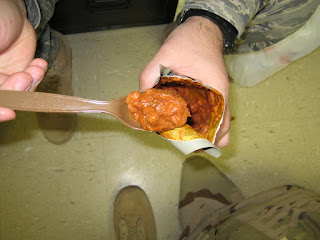
Everyone kicked in a few bucks for a microwave, a coffee maker and a variety of snack foods. People also put rejected MRE's on this table. The veggie burgerMREs aren't very popular here.
Saturday, May 3, 2008
Combat Lifesaver is complete
We spent all day out at the FOB doing our exercises and got a glimpse of where we will be living for 7 days starting Monday night. Shouldn't be too bad but less comfortable than the barracks and lots of body armor wearing everywhere we go. No computers either, but we will have access to an outlet, so that means I can bring my phone and my iPod. I'm also looking forward to being back with the other officers, as it has been a little lonely the past four days. I've realized how young these soldiers and Airmen are, although the Army Gaurdsmen and Reservist are a bit older. It's been fun to meet people from all over the country, everyone is mobilizing. I realized how disconnected most of us are from this war when places like this are a hive of activity, all directed towards getting soldiers on the ground in Iraq-- thousands of people coming and going. Everyone has a story, some of them strange and some of them horrific, some funny. People don't really talk about the war, other than talking about ways to fight better or stay safe. Some people don't want to go and others brag about how they just got back 6 months ago, and now volunteered for another 12. Talking with the medics really realigned my thinking and made me realize that the DoD releases scant information about casualties and deaths. I think that's a shame. I guess I'll write it all down and save it for after I am out of the service-- all I can say is, I'm glad I'm not going to Iraq.
Popping smoke
 Smoke for the incoming medevac chopper. The instructors gave us an A+ on the exercise.
Yes, that is real blood
 We train realistically. If the fake injuries would have resulted in significant blood loss we were expected to start IVs--- there will be more of this next week too. I'll probably have to do a few, as I am now one of about 33 CLS guys out of our group of 120. That means they'll spread us out within the ranks when we do convoys or foot patrols.
Perimeter security
 I'm supposed to be pulling security with these guys but I was taking photos instead.
Casualties outside the FOB
 One of final scenarios was to go on a foot patrol and respond to a casualty situation off the side of the road, outside the FOB. This is our CCP (Casualty Collection Point). We had to drag two big dudes and a woman out of Humvee and maintain a secure perimeter-- lots of fake mortars and small arms fire popping off. I learned today about the imporatnce of preplacing ear plugs on my helmet.
Extracting a casualty from a Humvee
 Harder than it looks with all the gear-- at least the Humvee isn't on fire.
Friday, May 2, 2008
Why does everyone in the Army have a southern accent?
Day three of CLS was today. I am officially classified as a "combat lifesaver" now. I got a 93% on the written test and passed all the demonstrations. Tomorrow we travel out to FOB Liberty (FOB is "forward operating base") for a one day training session with moulaged patients and a training course that has simulated small arms fire and mortars (pyrotechnics). We will be split up into two groups of six companies and basically run through one scenario in the morning.One is a foot patrol scenario and the other is an indirect fire mass casualty situation (like a base getting randomly mortared). We will then rest for lunch, and switch in the afternoon. We will need to treat patients, establish a casualty collection point and an LZ, and set a perimeter. The trick is to coordinate all of the different functions (treating wounded, carrying litters, etc) and still keep people with weapons directed outward. We will be expected to also demonstrate starting an IV in field conditions (in the mud and rain with bangs and booms). Because I am one of three officers out of the 63 personnel I may be pressed into a simulated leadership role in the afternoon. The two other officers (an Air Force Lt Col and a Navy Commander) are the acting commanders for the morning scenarios. The class is a mix of all three services but the Army are the only people who have any training in infantry organization, movement, and tactics. It should be interesting though. It will also be muddy and cold (see here). Yes yes, if it ain't rainin' we ain't trainin', or so they tell me. The photos should be great from that, if it isn't too rainy for the camera. I shot some poor photos today-- extracting casualties from a Humvee... so I won't include them.
The second part of the day included my second M9 class in the last two months. The M9 is this, in case you are wondering. It was a fast and efficient class and the instructor was very clear, although at the end of the every sentence he asked "Are you trackin'?" He must have said it 200 times and it about drove me nuts. The Army folks (and some overenthusiastic Airmen) answered his repetitive query with a "hooah", 200 times. I had this class because I need to qualify on the Army shooting range with both the M16 and the M9 this weekend. I had no problems with either "weapon system" (as they call it in the Army) at Nellis, so it shouldn't be a problem here. I should be able to get some good pics then too.
There was meatloaf and fried fish for dinner tonight, although I did not eat it. At least the breakfasts are decent. I need to get some pics of the chow.
--Jason
The second part of the day included my second M9 class in the last two months. The M9 is this, in case you are wondering. It was a fast and efficient class and the instructor was very clear, although at the end of the every sentence he asked "Are you trackin'?" He must have said it 200 times and it about drove me nuts. The Army folks (and some overenthusiastic Airmen) answered his repetitive query with a "hooah", 200 times. I had this class because I need to qualify on the Army shooting range with both the M16 and the M9 this weekend. I had no problems with either "weapon system" (as they call it in the Army) at Nellis, so it shouldn't be a problem here. I should be able to get some good pics then too.
There was meatloaf and fried fish for dinner tonight, although I did not eat it. At least the breakfasts are decent. I need to get some pics of the chow.
--Jason
Thursday, May 1, 2008


The other guy
I started an IV on this guy (after he stuck me). I did it in the first stick and everything was fine, but he passed out (and I took pictures) . Yes, he really passed out. You can see the saline lock in his right arm. He said later that the sight of his blood flowing out onto the table was too much. The medics don't let us use pressure on the vein to "acclimate" us to the sight of blood. It didn't work on this poor Airman.
 . Yes, he really passed out. You can see the saline lock in his right arm. He said later that the sight of his blood flowing out onto the table was too much. The medics don't let us use pressure on the vein to "acclimate" us to the sight of blood. It didn't work on this poor Airman.


Woops / Short version of Combat Lifesaver
I had a long entry I wrote last night but I forgot to synch that document to my flashdrive. Because so many Army folks are mobilizing through this base, computer time is at a premium. There are 21 computers for multiple thousands of transient soldiers, some coming in and some going out. Before I come over here to post I need to make sure that my emails and posts are written and all my photos are ready to transfer, otherwise it's just rude to make people wait. Today was day 2 of CLS training. So far it is very good training for treating the primary causes of death in OEF and OIF: bleeding from extremity wounds (including amputations), airway obstructions, and collapsed lungs. I never knew that there were alot of chest wounds because I figured the body armor was pretty good for that sort of protection. Apparently, the armor is good, but if a piece of shrapnel or a bullet enters the chest from one of the vulnerable areas (armpit, abdomen, crotch) then it will travel through the torso, exit, and then hit the plate and bounce back into the chest cavity. So we essentially learn to manage lots of bleeding, sucking chest wounds and collapsed lungs, and learn to monitor the airway. The Army trains people to insert a nasopharyngeal tube into the nose for any casualty who is unconscious or having problems breathing. The Army also REALLY emphasizes the use of tourniquets, because they have saved alot of people over the past 6 years. This stuff really brings the war up close and in my face. Makes it pretty damn scary when you talk all day about what is happening everyday. I wish the media could/would cover this more. When the term "defending our freedom" includes leaking cerebrospinal fluid, sucking chest wounds, and ruptured organs, it changes the feel of it...
Tuesday, April 29, 2008
Dirty Barracks
Monday, April 28, 2008
No son, that isn't Gatorade
The Army. A couple of initial observations, I’m sure I will have more. First off I think there is a disproportionate number of short NCO’s and officers in the Army. Yes, I’m tall and everyone probably seems short to me, but I’m not kidding; it seems like most of the Army guys here are very short. I swear that I haven’t seen an Army NCO or officer who is taller than about 5’7”. It seems like height is normally distributed among USAF personnel and the junior enlisted Army. I don’t know if it’s this part of the country or if the Army attracts and keeps short men. I just think it’s weird. Yes, I have an interpretation for that but I’ll keep it to myself. My brother in law will love these comments.
The second Army thing I’ve noticed (and just as funny) is that everything Army has to be stated in excruciatingly concrete terms. A few examples:
From tactical combat casualty care:
“Determine if the casualty is alive or dead. Provide tactical care to the LIVE casualty.
From the “Law of War”:
“Soldiers treat civilians humanely”.
The funniest one was at the gym (the last one isn’t funny). The spray bottles of bright blue cleaning solution hanging near all the exercise equipment say in hand written big black letters: “DO NOT DRINK”.
I think all of this has to do with the Army recruiting standards, or maybe it’s just Army. Now that’s funny. Hooah.
In all fairness, I am looking forward to seeing what they do right, which is without a doubt the combat side of things.
The second Army thing I’ve noticed (and just as funny) is that everything Army has to be stated in excruciatingly concrete terms. A few examples:
From tactical combat casualty care:
“Determine if the casualty is alive or dead. Provide tactical care to the LIVE casualty.
From the “Law of War”:
“Soldiers treat civilians humanely”.
The funniest one was at the gym (the last one isn’t funny). The spray bottles of bright blue cleaning solution hanging near all the exercise equipment say in hand written big black letters: “DO NOT DRINK”.
I think all of this has to do with the Army recruiting standards, or maybe it’s just Army. Now that’s funny. Hooah.
In all fairness, I am looking forward to seeing what they do right, which is without a doubt the combat side of things.
PT
Okay. It’s been a slow day. We had a morning formation (stood in a huge group) in the snow and got briefed by key personnel. You could only hear 50% of what was said due to the wind. In the morning, people who were missing gear were bussed out to some warehouse to get what they needed. The rest of us were left to occupy ourselves so I went to the base gym with a group of guys, ran 5k and rode the stationary bike for 15k. Tomorrow we start unit PT at 0600. I think it will be a formation run, breaking into two groups: those who run slower or faster than an 11 minute mile. That basically means that the Air Force runs really really slow, if 11 minutes is what delineates fast from slow.
Words say it all
I mentioned this in an earlier post, but I thought it was interesting so I will revisit it. We were told to drill on these “15 phrases” so we know them. What I found so fascinating was what the actual phrases say about our current military operations in OEF and OIF, mostly OIF. They sound like phrases from all the old WWII movies I saw when I was a kid—delivered in German accented English. I saw some irony in it, but I must be fair and point out that the phrases include the phrases “excuse me I’m sorry” and "do you need help", etc? I like the last one... There's so much that's funny about this, but I better keep my mouth shut--
Partial list of the “15 Common Phrases”
Stop!
Do you have an identification card?
What is your name?
Let me search your car.
Hands up!
Drop your weapons!
Put your weapons down.
Do you need help?
Do you need medical attention?
Excuse me I’m sorry
You can leave.
Partial list of the “15 Common Phrases”
Stop!
Do you have an identification card?
What is your name?
Let me search your car.
Hands up!
Drop your weapons!
Put your weapons down.
Do you need help?
Do you need medical attention?
Excuse me I’m sorry
You can leave.
Waiting for "chow"
 Long line at 0600 for breakfast. Apparently a bunch of guys just came in from the FOB. They served 700 soldiers and airmen in 1.5 hours.
Sunday, April 27, 2008
Slow news day
Waited around most of the day (yes, it called "hurry up and wait") and then had a Kurd teach us how to say "Drop your weapon", "I am going to search your car", and "Put your hands in the air" in Pashtun and Dari. Good stuff.

Weapons
 Two guns and alot of other stuff-- cleaning kits, extra magazines, slings, two holsters, etc...

Mountain Dew commercial
A common inspirational tactic in the military goes like this: prior to a large unit briefing show a video or photo montage of Soldiers or Airmen in Iraq and Afghanistan—usually a mix of handheld video camera shots of either things exploding, guns being discharged, depleted uranium shells from an A-10 strafing pickup trucks, or people walking around in full “battle rattle.” The default is for this to be played to a loud soundtrack of heavy metal, or some other sort of fast, aggressive music. Some of the video is harrowing—IED’s hitting a convoy, sometimes shot from inside the stricken vehicle. This technique has always seemed to resonate with a large portion of the crowd at these briefs—stimulating enthusiastic exclamation. This was the case when I saw this stuff at Wright-Patterson, Maxwell, and Nellis. At the start of the welcome brief today they had one of these running—a video montage of trainees engaging in all sorts of high speed training activities (heavy metal) and then later a video of course graduates who went to Iraq to work as trainers with the Iraqi police (hint: they walk and drive out on patrol with Iraqi police in Baghdad). It was a stark video — heavily armed man in body armor walking and smiling through scenes of urban chaos alternating with shots of smoking craters, bullet riddled cars, and soldiers posing for photos with small Iraqi children. The crowd was pretty silent, which is a notable comparison to how people react back at a base in the theater. It was the first time that I really felt the undercurrent here—that a lot of these Airmen (and Airwomen) feel that their pending piece of war may not be like a Mountain Dew commercial.
Saturday, April 26, 2008
Rand Report on mTBI and PTSD
Here is a report on the signature injuries of OEF and OIF. My mom actually forwarded me the PDF of the report but it includes data from a site visit the DoD did at Nellis AFB at our mental health clinic. This stuff has been all over the news but it isn't a front page story it seems. At the hospital we have been screening for head injuries alot more even if people weren't obviously injured by IED's or other blasts. The explosion overpressure in the vehicles does bad things to the brain, and the symptoms can be similar to symptoms of PTSD. I haven't read much of the report but I think the problems identified and the recommendations are right on.
Just an intro--
I never really mentioned the purpose of this weblog, so I will now. It will hopefully be a place for me to share some of my Air Force (and Army) experiences in 2008 with family and friends. Please feel free to add comments. I will try to supply some interesting narrative, photos, editorials, etc... I should be able to update it throughout my training and deployment.
-- JP
-- JP

Barracks 2640

A little shot of the quarters. The beds are more akin to hammocks. My bunk is just out of sight.
The Start
It all started at about 7pm on 24 April with a very tearful goodnight with Luke. He fell asleep next to me, tears in both our eyes. I couldn’t sleep at all that night so I turned off the alarm 1:45am and got up to get ready. Sneaking off while the kids were asleep was a good idea, as it would have killed me to hear Luke say “don’t leave daddy.” I was at the airport by 3am. I had to travel in uniform to avoid lost baggage (if you wear civvies you will be out of uniform once you arrive, and if your bag is lost, you’re screwed). My bags were lost (along with about 50 other people) but at least I had a complete uniform on me. I have now been wearing the same clothes for 38 hours…
At Chicago O’Hare a group of blue uniformed ladies were hanging out at the gate, handing out guardian angels and giving hugs, thanking all the airmen and soldiers for their sacrifice. In retrospect, it was nice to have it acknowledged, because I feel like I am sacrificing here at Fort McCoy—and I haven’t even deployed yet. Bad sign.
Fort McCoy is old and it feels old. Most of the buildings in this section of the base are dilapidated and worn looking—like something out of an old Army movie or like what I imagine a Soviet gulag looks like. I live in a two story WWII era barracks, with open bay sleeping arrangements. I am bedding down with about 15 airmen and sergeants, a Lieutenant, another Captain, a Chief Master Sergeant and a Lieutenant Colonel (the Chief and the Lt Col get their own room). The Lt Colonel is the class commander and the Chief is the superintendent, so it is kind of fortunate that I am getting to know them.
Although we are at an Army base, being trained by Army personnel, we have our own Air Force chain of command, which is good, due to the cultural differences. There are about 100 or so Air Force men and women here from a variety of career fields but all are headed towards deployments with the Army for either 179 days or 365 days. This is a testament about the state of the Army, that they need so many Airmen to fill these jobs. I have met one other psychologist and a psychiatrist, but they are headed to Iraq.
During our welcome briefing today we got a brief overview of why we do the training and what it will entail. The purpose of the training is to develop Army-compatible combat skills, kind of a “combat training for dummies”, if you will. They emphasized that, at this training, we leave our specialties behind and just focus on combat skills. This is in line with the Army philosophy where people are soldiers before anything else, even the medics. I have minor qualms with this, because I purposefully did not join the Army for exactly that reason—I don’t want to roam around outside the wire. I guess this exemplifies the fact that when you join the military, they own you, and they can make you go anywhere. At least they are giving me this training if that’s what they’re going to make me do!
Anyway, the training starts off with language and culture skills, then moves on to tactical driving and combat life saver courses. We then need to qualify on the Army shooting range for our weapons (officers need to qualify on both the M9 pistol and the M16). Part of the acculturation process is to carry your weapons at all times, practicing good safety and practicing just having the things on your body. After that we are scheduled to spend about 8 days at the sim FOB (Forward Operating Base) where we will practice base defense, entry control procedures, and other combat-oriented skills in field conditions. I’m sure we will eat a lot of MREs, take few showers, sleep on cots, all that good stuff. After the FOB we will be at the halfway point and I think we come back here for various and sundry trainings before spinning down the last week. There are no days off, no leaving base, no beer drinking, and I hear that the days will be a mix of long (18 hrs plus) and short (5hrs).
It doesn’t sound that great but I’m trying to reframe it. I’ve always been one who enjoys physical challenge, gaining new skills, and I like gear, so this is a good place for all that. The commander pointed out that we have to look at this as an opportunity to train with perhaps the best and most effective ground combat force the modern world has seen (best at blowing things up, just to clarify). Those words resonated with me, not because I particularly want these skills, but because I will have an opportunity to experience this machine from the inside, and maybe learn something about our nation and myself, even though I hope desperately that all of these skills will go entirely unused by me in the latter half of 2008.
I hope our bags get here so I can change clothes…
JP
At Chicago O’Hare a group of blue uniformed ladies were hanging out at the gate, handing out guardian angels and giving hugs, thanking all the airmen and soldiers for their sacrifice. In retrospect, it was nice to have it acknowledged, because I feel like I am sacrificing here at Fort McCoy—and I haven’t even deployed yet. Bad sign.
Fort McCoy is old and it feels old. Most of the buildings in this section of the base are dilapidated and worn looking—like something out of an old Army movie or like what I imagine a Soviet gulag looks like. I live in a two story WWII era barracks, with open bay sleeping arrangements. I am bedding down with about 15 airmen and sergeants, a Lieutenant, another Captain, a Chief Master Sergeant and a Lieutenant Colonel (the Chief and the Lt Col get their own room). The Lt Colonel is the class commander and the Chief is the superintendent, so it is kind of fortunate that I am getting to know them.
Although we are at an Army base, being trained by Army personnel, we have our own Air Force chain of command, which is good, due to the cultural differences. There are about 100 or so Air Force men and women here from a variety of career fields but all are headed towards deployments with the Army for either 179 days or 365 days. This is a testament about the state of the Army, that they need so many Airmen to fill these jobs. I have met one other psychologist and a psychiatrist, but they are headed to Iraq.
During our welcome briefing today we got a brief overview of why we do the training and what it will entail. The purpose of the training is to develop Army-compatible combat skills, kind of a “combat training for dummies”, if you will. They emphasized that, at this training, we leave our specialties behind and just focus on combat skills. This is in line with the Army philosophy where people are soldiers before anything else, even the medics. I have minor qualms with this, because I purposefully did not join the Army for exactly that reason—I don’t want to roam around outside the wire. I guess this exemplifies the fact that when you join the military, they own you, and they can make you go anywhere. At least they are giving me this training if that’s what they’re going to make me do!
Anyway, the training starts off with language and culture skills, then moves on to tactical driving and combat life saver courses. We then need to qualify on the Army shooting range for our weapons (officers need to qualify on both the M9 pistol and the M16). Part of the acculturation process is to carry your weapons at all times, practicing good safety and practicing just having the things on your body. After that we are scheduled to spend about 8 days at the sim FOB (Forward Operating Base) where we will practice base defense, entry control procedures, and other combat-oriented skills in field conditions. I’m sure we will eat a lot of MREs, take few showers, sleep on cots, all that good stuff. After the FOB we will be at the halfway point and I think we come back here for various and sundry trainings before spinning down the last week. There are no days off, no leaving base, no beer drinking, and I hear that the days will be a mix of long (18 hrs plus) and short (5hrs).
It doesn’t sound that great but I’m trying to reframe it. I’ve always been one who enjoys physical challenge, gaining new skills, and I like gear, so this is a good place for all that. The commander pointed out that we have to look at this as an opportunity to train with perhaps the best and most effective ground combat force the modern world has seen (best at blowing things up, just to clarify). Those words resonated with me, not because I particularly want these skills, but because I will have an opportunity to experience this machine from the inside, and maybe learn something about our nation and myself, even though I hope desperately that all of these skills will go entirely unused by me in the latter half of 2008.
I hope our bags get here so I can change clothes…
JP
Friday, April 25, 2008
At Fort McCoy...
Bags are lost (but weapons case arrived). Got bussed out to rural Wisconsin and introduced to WWII barracks, a WWII chow hall and dreary skies.
Subscribe to:
Posts (Atom)

